


Experienced truck accident attorneys who pursue full recovery for injury victims and their families throughout the DMV.
At The Law Firm of Frederick J. Brynn, P.C., we represent people hurt by commercial trucks throughout Washington, DC. Our Washington, DC truck accident lawyer has handled personal injury matters for more than 30 years, and the firm brings 75+ years of combined experience to claims involving tractor-trailers, delivery trucks, and other commercial vehicles. Contact us today to learn more about how we can help. We take these cases on a contingency basis.
Truck Accident Lawyer Washington, DC
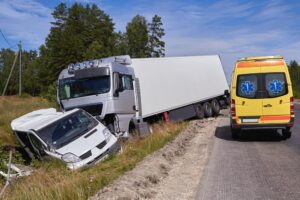
A truck accident claim is not a regular car accident case in larger packaging. The vehicles are different. The drivers operate under federal regulations the general motoring public never has to think about. The carriers carry far more insurance than typical drivers, and they fight harder to keep it. Investigations have to move quickly because the data that proves the case such as driver logs, electronic control module readings, and hours-of-service records can disappear within weeks.
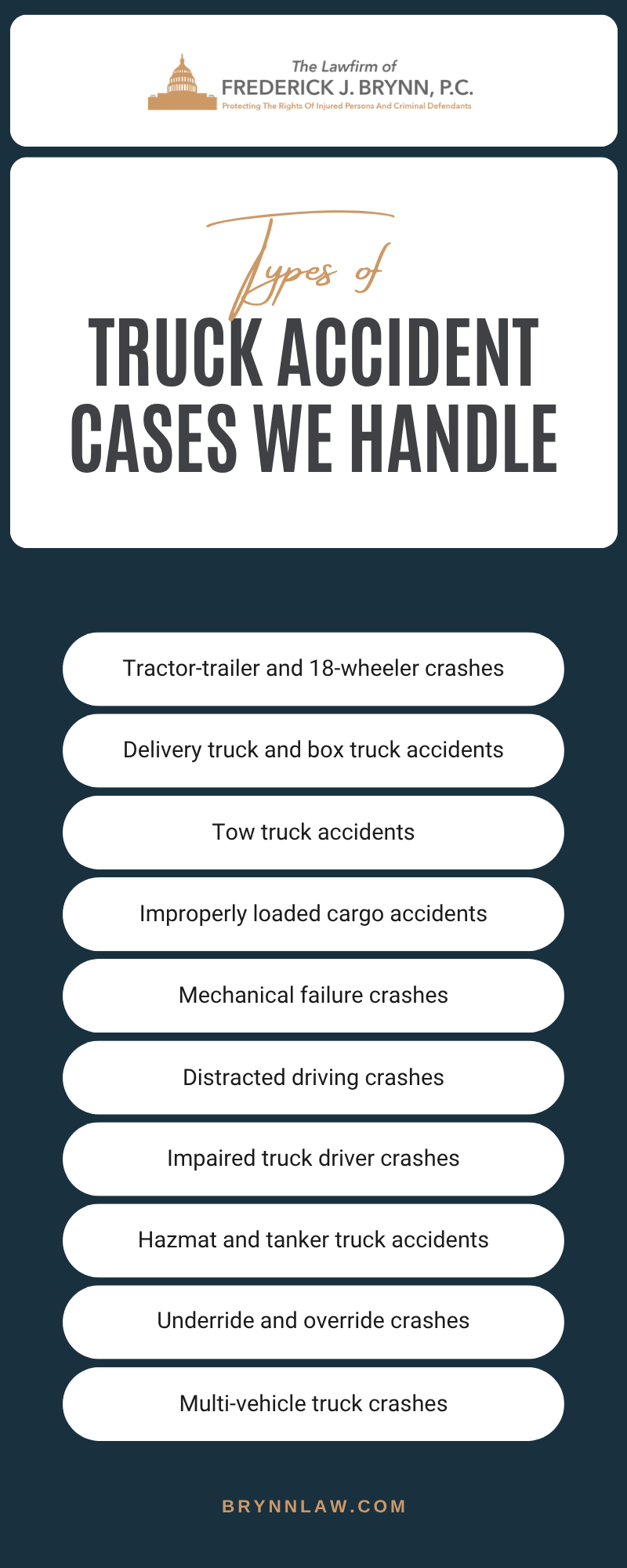
Types of Truck Accident Cases We Handle in Washington, DC

Truck crashes don’t fit a single mold. The vehicle, the cargo, the driver, and the carrier all change the shape of the case. Our firm represents injured people across the full range of commercial vehicle collisions.
- Tractor-trailer and 18-wheeler crashes. Fully loaded tractor-trailers weigh up to 80,000 pounds, and when one collides with a passenger vehicle, the injuries are often catastrophic. We pull driver logs, dispatch records, and electronic control module data to establish what the driver was doing in the minutes before impact.
- Delivery truck and box truck accidents. Local delivery vehicles operate under time pressure, and the drivers behind the wheel face quotas that incentivize unsafe driving. These commercial vehicle accidents happen often in dense corridors and frequently involve policies that require careful navigation.
- Tow truck accidents. Tow trucks operate in unusual roadway positions and create distinct hazards. We’ve handled tow truck claims involving disabled vehicles on the shoulder, recovery operations gone wrong, and tow vehicle drivers who caused crashes while responding to calls.
- Improperly loaded cargo accidents. Overloaded, unbalanced, or unsecured cargo causes rollovers, jackknifes, and falling-load crashes. Liability often extends beyond the driver to the shipper or the company responsible for loading the trailer.
- Mechanical failure crashes. Brake failures, tire blowouts, and steering defects often trace back to deferred maintenance. Federal regulations require systematic inspection and repair records, and we use those records to establish whether a preventable failure caused the wreck.
- Distracted driving crashes. Commercial drivers face the same distractions as everyone else, with higher stakes. We obtain phone records and onboard system data to establish what was happening in the cab when the crash occurred, in line with broader distracted driving investigation principles.
- Impaired truck driver crashes. Alcohol, illicit drugs, and improper use of prescription medications all show up in commercial driver impairment cases. The federal testing framework for drunk driving involving commercial drivers is stricter than the standard for ordinary motorists.
- Hazmat and tanker truck accidents. Crashes involving hazardous materials add layers of regulation, exposure pathways, and potential defendants. The shipper, the carrier, and the hazmat compliance contractor can all share responsibility.
- Underride and override crashes. When a passenger vehicle slides under a trailer, or when a truck rides over a smaller vehicle, the injuries are often fatal. Equipment standards and the adequacy of side guards become central issues.
- Multi-vehicle truck crashes. A single truck collision frequently triggers chain reactions involving several vehicles. We sort liability across the chain and identify every available insurance source.
Why Choose The Law Firm of Frederick J. Brynn, P.C. for Truck Accident Cases in Washington, DC?
Decades of Plaintiff-Side Trial Work in Washington, DC

Our founder, Frederick J. Brynn, has practiced personal injury law in Washington, DC for more than 30 years. The DC Bar admitted him in 1992, and he also holds bar admissions in Virginia and Vermont along with federal admissions in the U.S. District Courts for the Eastern District of Virginia and the District of Columbia. He earned a Martindale-Hubbell Notable Award for ethical standards and holds membership in the District of Columbia Trial Lawyers Association along with the American Bar Association.
Our firm has helped clients recover millions of dollars in personal injury matters. Trucking cases sit among the most demanding claims a personal injury lawyer in Washington, DC handles, because the carriers and their insurers approach every claim with their own investigators, their own reconstruction experts, and their own defense counsel. We meet that effort with our own preparation, our own specialists, and the kind of trial-readiness that drives real settlement value.
Contingency Representation
We work on a contingency basis on truck accident matters. The firm covers case costs as they come up, including accident reconstruction, expert reports, deposition fees, and court costs, and we recover those costs from any settlement or verdict. Attorney fees come only from recovery. If we don’t recover, you don’t pay. That structure exists precisely because trucking cases are expensive to prosecute and impossible for most injured people to fund out of pocket.
Understanding Truck Accident Cases

A truck accident case in DC turns on several legal questions, and each one has implications for strategy. Who was negligent, and in what ways? Which parties share legal responsibility for the resulting harm? What federal and District rules were violated? What does the law allow you to recover? Each question opens a separate line of investigation, and the answers shape both the litigation path and the settlement value.
Damages, Liability, and Compensation for Truck Accident Cases
Liability in a DC truck case usually starts with the driver. From there, it often expands. The motor carrier may be liable for negligent hiring, training, supervision, or retention. A maintenance contractor may share responsibility if equipment failed because of poor service. A shipper may face liability if cargo was loaded improperly. A broker may answer for selecting an unsafe carrier. Each defendant brings additional insurance, and identifying every available policy is part of the work.
DC’s contributory negligence rule complicates the defense picture significantly. If a defendant proves the injured driver contributed to the crash in any meaningful way, recovery can be barred entirely. Trucking defense lawyers know this. They push contributory negligence arguments aggressively. Our job is to build a case that refutes those arguments before they take hold.
Damages in a truck accident case typically include:
- Past and future medical expenses
- Lost wages and reduced earning capacity
- Pain, suffering, and other non-economic losses
- Long-term care and rehabilitation costs
- Property damage to the vehicle and its contents
- Permanent impairment, disfigurement, or disability
- Wrongful death damages where the crash was fatal
- Punitive damages in cases involving particularly egregious conduct
What Are Important Aspects of a Truck Accident Case?
A few aspects drive value and outcome more than others. The evidence preserved in the first weeks. The accuracy of the reconstruction. The credibility of the testimony. The completeness of the federal compliance record.
- Driver hours-of-service logs and electronic logging device data
- Dispatch records and communication between driver and carrier
- The driver’s qualifications, training history, and prior incident record
- Vehicle maintenance and inspection records
- Electronic control module (“black box”) data from the truck
- Police crash investigation and any commercial vehicle inspection report
- Witness statements taken before recollection fades
- Photographs of the scene, the vehicles, and the cargo
What Is the Truck Accident Case Timeline?
Truck accident cases tend to take longer than typical car accident claims. The investigation is deeper. The defendants are better resourced. Settlement value depends on the medical picture stabilizing, which itself can take months.
- Immediate evidence preservation, including preservation letters to the carrier
- Initial medical treatment and ongoing care, usually the first six to twelve months
- Investigation, including driver record review, FMCSA data review, and reconstruction
- Demand package preparation, typically once you reach maximum medical improvement
- Pre-suit negotiation with the carrier and its insurer
- Filing suit, where the carrier refuses fair value
- Discovery, depositions, and motion practice
- Mediation or trial
What Should You Bring to Your Truck Accident Consultation?
The more you bring, the more accurately we can evaluate the case. Don’t worry about organizing it.
- The police or crash report, if you have a copy
- Photographs of the scene, the vehicles, and your injuries
- The truck’s identifying information, including the carrier name and DOT number if available
- Names and contact information for witnesses
- Insurance information for every party involved, including your own
- Medical records, discharge paperwork, and bills received so far
- Documentation of lost income and any time missed from work
A consultation typically runs about an hour. We use that time to walk through the crash, identify the likely defendants and insurance sources, explain the federal regulatory issues that may apply, and discuss how we’d approach the case.
What Are Important DC Legal Resources for Truck Accident Cases?

Clients sometimes want to read the underlying law themselves. Several public resources help.
- The DC Code sets out Washington, DC’s statute of limitations for personal injury actions, which is generally three years from the date of injury.
- DC’s negligence framework follows pure contributory negligence, and DC Courts civil division resources provide procedural background.
- The Federal Motor Carrier Safety Administration publishes the federal regulations governing commercial drivers and carriers.
- The Federal Motor Carrier Safety Regulations themselves are publicly available and cover hours of service, vehicle maintenance, driver qualifications, and reporting requirements.
This is a directory, not legal advice on a particular case. Statutes change, deadlines vary based on the specific facts, and the way federal regulations interact with state-law claims is a separate analysis.
Reach Out to The Law Firm of Frederick J. Brynn, P.C. to Schedule a Consultation
If a truck crash has left you injured, we’re glad to talk through what happened. We work on contingency, so there are no attorney fees unless we recover for you. Contact us to set up a time. We typically respond the same business day.
Washington DC Truck Accident Infographic
Truck Accident Statistics in Washington, DC

Large truck crashes account for a disproportionate share of serious roadway injuries. According to NHTSA crash data, thousands of people die each year in crashes involving large trucks, and tens of thousands suffer injuries. The agency’s Fatality Analysis Reporting System tracks truck-involved fatalities at the state and district level.
The Federal Motor Carrier Safety Administration’s crash statistics document the specific factors that drive these numbers. Driver fatigue contributes to a meaningful share of fatal truck crashes, and improper maintenance and equipment failures account for another substantial portion. Bureau of Labor Statistics workplace fatality data shows that commercial driving consistently ranks among the most dangerous occupations in the country. Within Washington, DC, heavy truck traffic on I-295, New York Avenue, and the Anacostia Freeway creates conditions where serious crashes recur, and DDOT Vision Zero data tracks where commercial vehicle incidents cluster on DC streets.
Common Causes of Truck Accidents in Washington, DC

Truck crashes don’t happen at random. The same factors recur across cases, and identifying the cause matters because it often points to who bears responsibility.
- Driver fatigue. Long hours behind the wheel slow reaction time and impair judgment in the same way alcohol does. Federal hours-of-service rules exist because the science is clear. When drivers and carriers ignore those rules, fatigue-related crashes follow.
- Pressure from carriers. Trucking companies set delivery schedules, and unrealistic schedules push drivers to speed, skip rest breaks, and falsify logs. The pressures and regulations of the trucking industry often sit behind individual driver behavior.
- Distracted driving. Cell phones, onboard navigation systems, and dispatch communications all pull driver attention away from the road. We routinely subpoena phone records to establish what the driver was doing at the moment of impact.
- Speeding and aggressive driving. Heavy vehicles require far more stopping distance than passenger cars, and a truck driver who speeds eliminates the margin that prevents minor situations from becoming catastrophic crashes.
- Impaired driving. Alcohol and drugs show up in truck crash investigations more often than the industry acknowledges. Federal testing requirements catch some of these cases, but not all.
- Inadequate driver training. Carriers sometimes hire and dispatch drivers who lack the experience or training to handle the equipment they’re assigned. The hiring decision itself can support a negligent hiring claim.
- Improper loading. A trailer loaded with the weight too high, too far back, or unsecured creates handling problems that produce rollovers and jackknifes. Loaders, shippers, and carriers can all share responsibility for loading failures.
- Mechanical failure. Brake failures, tire blowouts, and steering problems often trace back to maintenance the carrier should have performed. The federal record-keeping requirements make these failures easier to prove than they used to be.
- Poor weather and road conditions. Snow, ice, rain, and reduced visibility don’t excuse commercial drivers who fail to adjust their driving. Professional drivers are held to a higher standard than ordinary motorists in conditions like these.
- Brokerage and dispatch failures. Freight brokers and dispatchers who select unqualified carriers, or who dispatch drivers who shouldn’t be on the road, can be liable for the harm those decisions cause.
Washington, DC Truck Accident FAQs

How long do I have to file a truck accident claim in DC?
Washington, DC generally allows three years from the date of injury to file a personal injury lawsuit. Claims against the Washington, DC government carry shorter notice requirements measured in months. The clock can also shift depending on the specific facts, so consulting counsel well before the three-year mark is the safest course.
Who can be held responsible after a truck crash?
Truck cases often involve more than one defendant. The driver is the most obvious party, but the motor carrier, the company that loaded the cargo, the maintenance contractor, the freight broker, and even the truck or component manufacturer can share liability depending on the circumstances. Each defendant brings additional insurance, which expands the potential recovery.
What’s the difference between a truck accident case and a regular car accident case?
The vehicles are different, the regulations are different, and the defendants are different. Trucking cases involve carriers with substantial insurance and sophisticated defense teams. They require federal regulatory analysis, electronic data preservation, and accident reconstruction beyond what a typical car accident demands. The cases also tend to involve more serious injuries and longer recoveries.
What is the “black box” in a truck, and why does it matter?
Commercial trucks carry electronic control modules and increasingly carry electronic logging devices. Both record operational data such as speed, braking, throttle position, and driver hours. That data can establish exactly what was happening in the seconds before impact, and securing it before the carrier overwrites or disposes of it is one of the first priorities in a truck case.
Can I still recover compensation if I was partially at fault?
DC’s contributory negligence rule makes this harder than it is in most states. A defendant who proves the injured person contributed to the crash in any meaningful way can defeat the claim entirely. We address this risk from the first investigation by building a case that refutes contributory negligence arguments before they take hold.
How much is a truck accident case worth?
No responsible lawyer can answer that in the first call. Value depends on injury severity, future medical needs, lost earning capacity, the available insurance coverage, and the strength of the liability case. We provide realistic ranges once the medical picture stabilizes and the full investigation comes together.
Should I take the insurance company’s first offer?
Almost never. First offers test whether you have counsel and whether you understand what the case is worth. They typically omit future medical care, future lost wages, and full non-economic damages, and they assume injuries will heal more cleanly than serious truck-crash injuries actually do.
What if the truck driver works for an out-of-state company?
Out-of-state carriers can still be sued in DC for crashes that occurred in Washington, DC. The procedural rules for serving and obtaining jurisdiction over out-of-state defendants are well established, and the federal regulatory framework applies regardless of where the carrier is based.
Can I sue the carrier if the driver was clearly at fault?
In most cases, yes. Carriers can be liable directly for negligent hiring, training, supervision, retention, or entrustment. They can also be vicariously liable for the driver’s negligence under respondeat superior when the driver was acting within the scope of employment.
What if my loved one died in a truck crash?
Surviving family may pursue a wrongful death claim, which has its own procedural rules and a shorter limitations period than ordinary injury claims. The damages framework differs as well, and the case proceeds through the deceased’s personal representative.
How long does a truck accident case take?
Many resolve within twelve to eighteen months, though serious-injury cases often take longer. The medical picture has to stabilize before settlement value can be assessed accurately, and contested liability extends the timeline further when the case has to be litigated.
What if I was driving for work when the crash happened?
When the injured person was driving for work, both workers’ compensation and a third-party liability claim may apply. The two systems interact in specific ways, and pursuing both correctly requires coordination so that one doesn’t unintentionally reduce recovery under the other.
What does it cost to hire your firm?
Nothing upfront. We work on contingency. The firm advances the case costs, and attorney fees come from the recovery. If we don’t recover, you don’t pay.
Local Information for Washington, DC Truck Accident Cases

Common Locations for Truck Accidents in DC
Heavy truck traffic concentrates on certain corridors, and serious crashes follow the same patterns year after year.
- I-295 and the Anacostia Freeway — High-speed truck traffic with frequent merging conflicts.
- New York Avenue NE — Heavy commercial truck use near rail yards and industrial properties.
- South Capitol Street — Mixed truck and passenger traffic with poor lane discipline.
- I-395 through Washington, DC — Federal highway truck traffic moving through the city.
- The 11th Street Bridge corridor — Truck traffic merging from multiple highways.
- Rhode Island Avenue NE — Commercial deliveries and truck traffic supporting adjacent properties.
What Are Important Local Resources for DC Truck Accident Cases?
The resources below come up regularly in truck accident matters. We list them as a starting point.
- DC Metropolitan Police Department — (202) 727-9099. Non-emergency reporting and crash records.
- MedStar Washington Hospital Center — (202) 877-7000. Level I trauma center.
- George Washington University Hospital — (202) 715-4000. Level I adult trauma care.
- Howard University Hospital — (202) 865-6100. Trauma and emergency care.
- Federal Motor Carrier Safety Administration — (800) 832-5660. Commercial carrier records and safety data.
- DC Department of Motor Vehicles — (202) 737-4404. Crash report requests.
- DC Department of Transportation — (202) 673-6813. Roadway and crash data.
The Law Firm of Frederick J. Brynn, P.C. provides this list for convenience only. Inclusion does not constitute an endorsement of any organization or agency, and these resources operate independently of our firm.
About the Attorney
Frederick J. Brynn, founder of the firm, has practiced personal injury law in Washington, DC since 1992. He holds bar admissions in DC, Virginia, and Vermont, along with federal admissions in the U.S. District Courts for the Eastern District of Virginia and the District of Columbia. He handles truck accident matters for the firm and has built more than three decades of experience pursuing complex commercial vehicle claims against well-resourced trucking defendants.
What Our Clients Say

★★★★★
“Mr. Bryman always taken very good care of me very time I was in an accident he has always made me feel that he understands my pain and hurt. Mr. Bryman staff has always made me feel like I was the only client but I know he has more me as clients I will always recommend him to others and I have done that over the years I have been with Mr. Bryman over 27 years and can stand behind him a hundred percent for the work and support and service that he does for me.” — Mary Gates
Read more reviews on our Google Business Profile.
The Law Firm of Frederick J. Brynn, P.C. – Washington, DC Truck Accident Lawyers
Washington, DC 20003
Contact The Law Firm of Frederick J. Brynn, P.C.
If a truck crash has left you injured, we’re ready to talk through your case. The firm represents injured people on a contingency basis, which means there are no attorney fees unless we recover for you. In a consultation, we’ll walk through what happened, identify the likely defendants and insurance sources, explain the federal regulatory framework that may apply, and lay out how we’d approach the claim. We answer the phones 24/7 and typically respond to new inquiries the same business day. Contact us to get started.
Free Case Reviews
Practice Areas
View All Practice AreasTestimonials


Contact Us
FREDERICK J. BRYNN, P.C.
922 Pennsylvania Avenue SE, Suite 100
Washington, DC 20003