

Experienced DWI attorneys who represent drivers facing charges throughout the DMV.
At The Law Firm of Frederick J. Brynn, P.C., we defend drivers facing DWI charges in DC Superior Court. Our Washington, DC DWI attorney has practiced criminal defense for more than three decades, and the firm brings 75+ years of combined experience to courtrooms across DC, Maryland, and Virginia. Call our firm to set up a time to speak with a lawyer who DC drivers trust when their record is on the line.
DWI Attorney Washington DC
A DWI case in Washington, DC runs on two parallel tracks. The criminal case proceeds in DC Superior Court, where the prosecution has to prove the charges beyond a reasonable doubt. The administrative case proceeds through the DMV, where your license is at stake on its own schedule. Both tracks involve short deadlines and produce consequences that follow you for years. We work both sides of the case from the start.
Types of DWI Cases We Handle in Washington, DC
DWI charges in Washington, DC take several forms, and the form matters. Each carries its own elements, evidence problems, and sentencing exposure. Our firm defends drivers across the full range of impaired driving allegations.
- First-offense DWI. A first DWI in DC is a misdemeanor, but jail exposure, fines, and license consequences come with the territory. We challenge the stop, the testing, and the officer’s observations as part of a first offense and multiple offense DUI defense.
- Repeat-offense DWI. Second and third DWI charges carry mandatory minimum jail time and steeper penalties. The prosecution scrutinizes prior convictions, and we examine whether any of those priors are vulnerable to challenge.
- Drug-related DWI. Washington, DC prosecutes driving while impaired by marijuana, prescription medications, and controlled substances. The science on drug impairment is more contested than alcohol, and we push hard on the toxicology.
- Breathalyzer refusal cases. Refusing a breath test triggers automatic license consequences under DC’s implied consent law. The refusal itself can be challenged on grounds related to whether the advisement was given correctly.
- High-BAC and aggravated cases. Elevated BAC readings unlock enhanced penalties. We scrutinize calibration records, operator certification, and the testing protocol for procedural failures.
- DWI with accident or injury. When a crash is involved, the case crosses into more serious territory. Felony exposure rises sharply when injuries occur, and the criminal case may interact with civil claims by the injured parties.
- License suspension and administrative hearings. The driver’s license suspension side of a DWI runs on its own clock. Missing the deadline for an administrative hearing can cost you driving privileges before the criminal case is ever scheduled.
- Out-of-state driver DWI. If you live in Maryland, Virginia, or elsewhere and were arrested in DC, the case has cross-jurisdictional consequences. We coordinate with the rules in your home state to limit the damage.
DWI Infographic
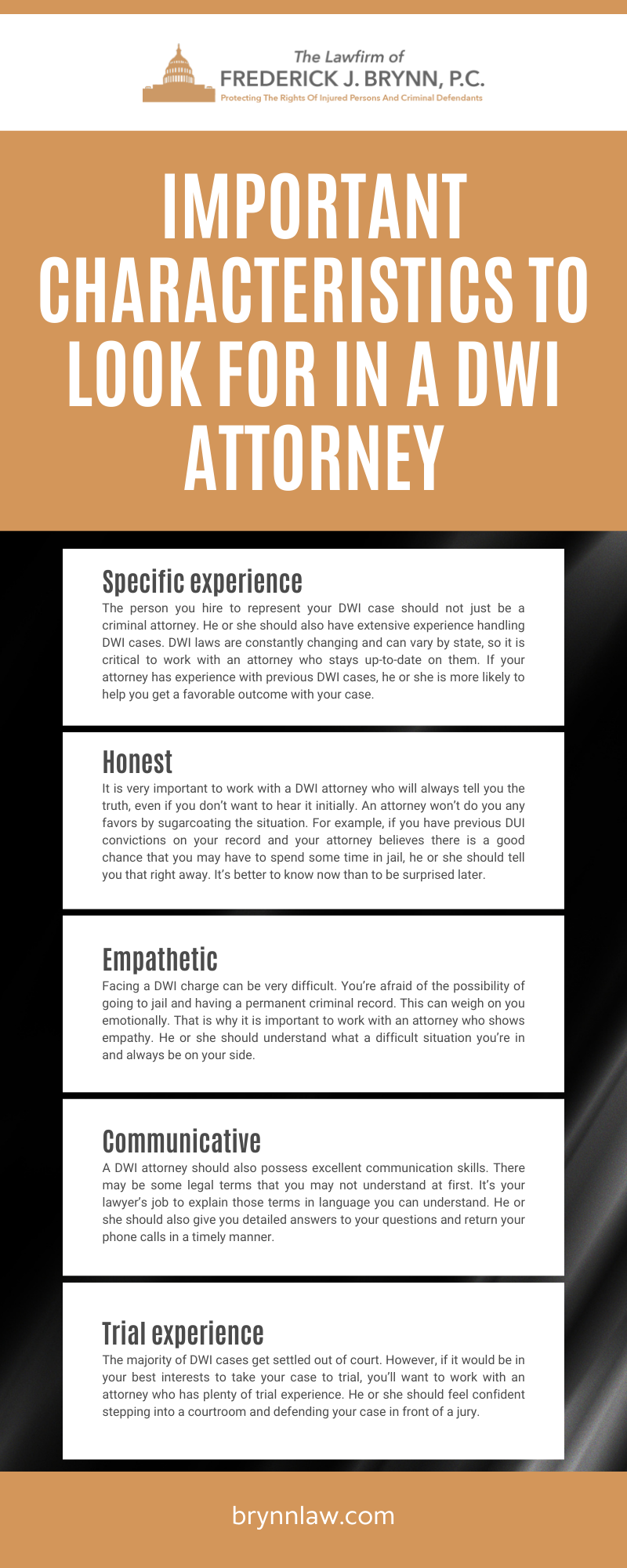
Why Choose The Law Firm of Frederick J. Brynn, P.C. for DWI Defense in Washington, DC?
Three Decades of Criminal Defense Work in DC Superior Court
Frederick J. Brynn founded the firm and has practiced criminal defense for more than 30 years. The DC Bar admitted him in 1992, and he holds additional admissions in Virginia and Vermont along with federal admissions in the U.S. District Courts for the Eastern District of Virginia and the District of Columbia. He earned a Martindale-Hubbell Notable Award for ethical standards and is a member of the District of Columbia Trial Lawyers Association. Stephen F. Brennwald brings 40 years of legal practice, with bar admissions in DC and Maryland.
That bench matters in DWI defense, where the science is technical and the administrative deadlines are unforgiving. As a criminal defense lawyer in Washington, DC, our firm works the case from both ends: challenging the criminal charge while preserving driving privileges through the administrative process. Our track record includes charges reduced and dismissed, cases resolved without conviction, and trial outcomes earned through the kind of preparation these cases require.
Understanding DWI Cases
A DWI charge in DC turns on a handful of legal questions. Was the stop lawful? Was there probable cause to arrest? Was the testing performed and recorded correctly? Was the chemical evidence reliable? Each question is an opportunity for the defense, and each requires close work with the evidence.
Charges, Penalties, and Defense Strategies for DWI Cases
DWI in DC focuses on observable impairment, often without a specific BAC threshold. The offense is a misdemeanor on a first conviction, though the consequences extend well beyond what the statute lists. Defense strategy usually begins with the stop and the field testing.
Penalties typically include:
- Jail time, with mandatory minimums on repeat offenses
- Fines and court costs
- License suspension or revocation
- Mandatory alcohol education or treatment
- Ignition interlock device requirements
- A permanent criminal record absent successful defense
What Are Important Aspects of a DWI Case?
A few aspects drive outcomes more than others. The strength of the stop. The reliability of field sobriety testing. The chemical evidence and the chain of custody behind it.
- The legality of the traffic stop and any extended detention
- Probable cause for arrest
- Administration of standardized field sobriety tests
- Calibration and maintenance records for breath testing equipment
- Officer certification for operating the testing equipment
- Body-worn camera footage compared against the officer’s report
What Is the DWI Case Timeline?
DWI cases in DC follow a recognizable rhythm, though the administrative track moves faster than the criminal one.
- Arrest, booking, and release on citation or after a brief hold
- Administrative license review with short deadlines to request a hearing
- Arraignment in DC Superior Court
- Discovery, including police reports, body-worn camera footage, and testing records
- Pretrial motions, including motions to suppress
- Plea negotiations or trial preparation, then trial or disposition
What Should You Bring to Your DWI Consultation?
Bringing relevant materials lets us evaluate the case accurately from the first meeting.
- Citations, charging documents, or court paperwork you’ve received
- Any notices from the DMV about your license
- The arrest report if you have a copy
- The name of the arresting officer and the precinct
- A written timeline of what happened, while memory is fresh
The consultation typically runs about an hour. We use that time to walk through what happened, identify the defenses available, explain the administrative track, and discuss realistic outcomes.
What Are Important DC Legal Resources for DWI Cases?
Drivers sometimes want to read the underlying law themselves. Several public resources help.
- The DC Code covers Washington, DC’s impaired driving statutes under Title 50.
- The DC Department of Motor Vehicles administers license suspensions, hearings, and reinstatements.
- DC Courts publishes information on the Criminal Division and case procedures.
- The DC Office of the Attorney General prosecutes misdemeanor DWI cases in Washington, DC.
These are starting points, not legal advice on a particular case. Statutes change, deadlines vary based on the specific charge, and a court’s application of the law to your situation is its own analysis.
Reach Out to The Law Firm of Frederick J. Brynn, P.C. to Schedule a Consultation
If you’ve been charged with DWI in Washington, DC, time matters. License deadlines run in days, not weeks. Contact us to set up a time to talk through your case. We answer the phones 24/7 and typically respond to new inquiries the same business day.
DWI Statistics in Washington, DC
Impaired driving remains a persistent problem on District roads even as national numbers improve. Federal crash data show 14 people died in alcohol-impaired-driving crashes in Washington, DC in 2023, up from 12 the year before, at a time when most states recorded declines.
Nationally, NHTSA drunk driving statistics attribute roughly 30 percent of all traffic deaths to crashes involving an impaired driver, and the rate of impairment among drivers in fatal crashes runs about three times higher at night than during the day.
DC’s Metropolitan Police Department runs sobriety checkpoints and drunk driving prevention campaigns throughout the year, and the city’s Vision Zero program tracks impaired driving as one of its priority crash factors. Those enforcement priorities translate directly into arrests, and every arrest becomes someone’s case.
Mistakes That Can Damage Your DWI Case
Most of the damage in a DWI case happens early, before an attorney is ever involved. The common mistakes people make when facing any criminal charge apply here, and impaired driving cases add several of their own. Avoiding these errors preserves defenses that cannot be recovered later.
- Explaining yourself to the officer. Drivers often believe they can talk their way out of an arrest. They cannot, and everything said during a DUI stop becomes evidence. Answering where you were coming from and how much you had to drink builds the prosecution’s case for it. Identify yourself, be polite, and decline to discuss your evening.
- Treating the license deadline as an afterthought. The criminal court date is weeks away, but the window to protect your driving privileges is measured in days. Drivers who set the paperwork aside frequently lose their license before they ever see a courtroom.
- Assuming the machine is always right. Breathalyzer tests depend on calibration, maintenance, and proper operation, and each of those is documented in records the defense can obtain. Accepting the number on the printout as unchallengeable is a mistake prosecutors are happy to let you make.
- Posting about the arrest online. A photo from the bar earlier that night, a joke about the arrest, or a complaint about the officer can all surface in court. Nothing about a pending case belongs on social media, and deleting posts after the fact creates its own problems.
- Underestimating a first offense. Because a first DWI is a misdemeanor, some drivers treat it as a traffic ticket with extra steps. The consequences of a DUI arrest reach into employment, security clearances, insurance, and professional licensing, and in a city where many careers depend on a clean record, that reach is longer than most people expect.
- Pleading guilty at arraignment to get it over with. A quick plea trades a permanent record for short-term relief, and it happens before anyone has examined the stop, the testing, or the paperwork. The time to evaluate a plea is after discovery, not before it.
- Waiting weeks to hire counsel. Video footage gets overwritten, administrative deadlines pass, and memories fade. The steps taken immediately after getting charged with a DWI shape every option that follows, and early representation costs nothing extra compared to late representation.
Washington, DC DWI Lawyer FAQs
What is the difference between DWI and DUI in Washington, DC?
DC charges them as separate offenses. DWI rests on a chemical test result at or above the legal limit, while DUI rests on proof of impairment and can be charged even when the test result falls below that threshold. A DUI charge often accompanies or substitutes for DWI when the testing is incomplete or contested.
Is a DWI a felony or a misdemeanor in DC?
A standard DWI in Washington, DC is a misdemeanor. Whether a charge is a felony or a misdemeanor matters less than people assume, though, because misdemeanor convictions still carry jail exposure, license consequences, and a permanent record. Aggravating factors and repeat offenses raise the stakes considerably.
Can I refuse the breath test?
You can, but refusal carries its own consequences. Under DC’s implied consent framework, choosing to refuse a breathalyzer test triggers automatic license penalties, and the refusal itself can be used against you in the criminal case. Whether refusal helped or hurt depends entirely on the facts, which is a conversation to have with counsel.
Will I go to jail for a first offense?
Jail is possible but far from automatic on a first offense. The potential penalties depend on your record, the test results, and any aggravating factors like an accident or a child in the vehicle. Many first offenses resolve without incarceration when the defense is handled properly from the start.
How much does a DWI attorney in Washington, DC cost?
Fees vary with the complexity of the case, the court, and whether the matter is headed to trial. The defense attorney cost for a straightforward first offense differs substantially from a refusal case with a contested motion schedule. Ask for the fee structure in writing before hiring anyone.
Can a DWI be sealed in DC?
Washington, DC allows record sealing for certain offenses and outcomes, with waiting periods and eligibility rules that depend on how the case ended. The process resembles getting a DUI expunged in other jurisdictions, though DC uses its own terminology and standards. Sealing is worth pursuing, because the record otherwise remains visible.
Who prosecutes DWI cases in Washington, DC?
The DC Office of the Attorney General prosecutes impaired driving cases, unlike most serious crimes in the area, which federal prosecutors handle. Knowing who files charges matters because each office has its own policies on plea offers, diversion, and trial posture.
I live in Maryland or Virginia. What happens to my license?
DC cannot suspend a license it did not issue, but it can revoke your privilege to drive, and it reports the outcome to your home state. Maryland and Virginia then apply their own consequences under their own rules, which is why out-of-state drivers need the full picture before making decisions.
What if drugs were involved instead of alcohol?
DC prosecutes drugged driving under the same impaired driving framework, and separate drug offenses charges can accompany the driving case when a substance is found in the vehicle. Drug impairment cases raise different scientific questions than alcohol cases, and the toxicology deserves close scrutiny.
Should I just plead guilty and move on?
Not before the evidence has been reviewed. Many drivers assume drunk driving charges are unbeatable, but suppression motions, testing problems, and procedural failures resolve cases more often than people expect. A guilty plea is permanent. The evaluation that should precede it takes a few weeks.
Is diversion available for a DC DWI?
In some cases, prosecutors offer agreements that can lead to reduced charges or dismissal after conditions like treatment or community service are completed. Eligibility depends on your record, the facts of the stop, and current charging policies. An attorney who negotiates with the prosecuting office regularly will know what is realistic.
Local Information for Washington, DC DWI Cases
Washington, DC Courthouses and Local Criminal Justice Resources
Every DWI prosecution in DC moves through the Superior Court of the District of Columbia at the Moultrie Courthouse, 500 Indiana Avenue NW. Initial appearances for adults are held in courtroom C-10 on the courthouse’s C level, and misdemeanor calendars move quickly once a case is arraigned. The license side of the case proceeds separately through DC DMV Adjudication Services at L’Enfant Plaza. Familiarity with both buildings, and with the people who staff them, is part of what effective DWI representation in Washington, DC looks like.
What Are Important Local Resources for Washington, DC DWI Cases?
Drivers navigating a DWI case in the DMV deal with a small set of institutions, and knowing how to reach them saves time at every stage.
- Superior Court of the District of Columbia, (202) 879-1010
- DC DMV Adjudication Services, (202) 737-4404
- Public Defender Service for the District of Columbia, (202) 628-1200
- Pretrial Services Agency for the District of Columbia, (202) 220-5500
We provide this list for general informational purposes only. We are not affiliated with these offices, and their inclusion here is not an endorsement.
About The Law Firm of Frederick J. Brynn, P.C.
The Law Firm of Frederick J. Brynn, P.C. has defended District drivers from an office on Pennsylvania Avenue SE, minutes from the Moultrie Courthouse where these cases are heard. Stephen F. Brennwald belongs to the Superior Court Trial Lawyers’ Association, an affiliation rooted in the same courthouse where every DC DWI case begins and ends. That proximity is practical, not symbolic, because impaired driving defense rewards attorneys who appear before these judges and negotiate with these prosecutors week after week.
What Our Clients Say
⭐⭐⭐⭐⭐
“The best lawyer and staff hands down ive been dealing with mr. Brynn since 2005 third case satisfaction every last time, and my friends and family think the same” — Darnell Christian
Read more reviews on our Google Business Profile.
Contact The Law Firm of Frederick J. Brynn, P.C.
A DWI charge puts your record, your license, and in some careers your livelihood on the line at the same time. The earlier a DWI attorney in Washington, DC reviews the stop and the testing, the more of those interests can be protected. When you call, we will listen to what happened, explain how the criminal and administrative tracks will unfold, and give you a straightforward assessment of your options. Your initial case review is free, and our phones are answered 24 hours a day, seven days a week. Contact us to schedule a time to talk.
The Law Firm of Frederick J. Brynn, P.C.
922 Pennsylvania Avenue SE, Suite 100
Washington, DC 20003